
BLOG

- Home
- Blog
- Plastic Polymer Composite Article
- What is pressure forming? How it works in the plastics industry
What is pressure forming? How it works in the plastics industry
October 02,2026
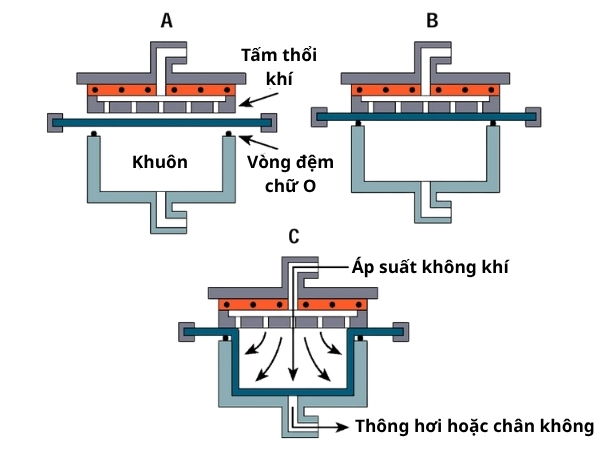
When a business needs to produce plastic parts with surface sharpness comparable to injection molding but at production volumes too low to justify the cost of steel tooling, what is the most suitable solution? Pressure forming technology is the answer for balancing investment budget with finished part quality. This article will help you understand the operating principle, economic comparison, and optimal material selection with APEX Vietnam.
What is pressure forming?
What is pressure forming?
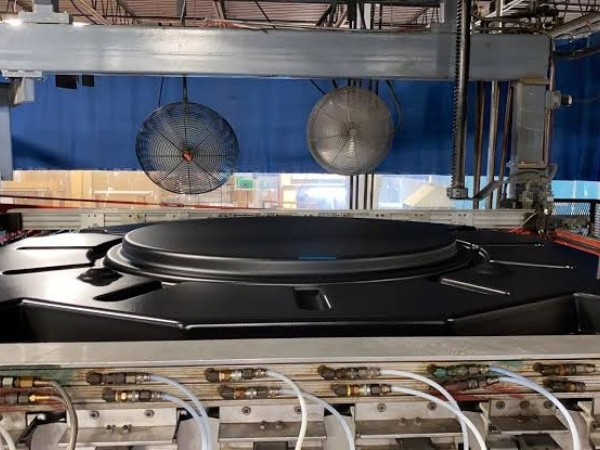
Pressure forming is a thermoforming technique that uses compressed air to press a softened plastic sheet tightly against the mold surface. The method applies to thermoplastic materials, producing parts with sharp lines and high surface detail. It is a suitable solution for medium production volumes where tooling cost savings are needed.
Operating principle of pressure forming
The principle of pressure forming is based on generating a large pressure differential across both surfaces of a softened plastic sheet. Compressed air presses the plastic tightly against every fine detail of the mold before the cooling system fixes the part shape.
The standard operating process consists of 6 steps:
- Sheet clamping: A metal frame holds the edges of the plastic sheet firmly to prevent deformation during heating.
- Heating: Infrared heating elements heat the plastic sheet to a pliable state at temperatures ranging from 149°C to 260°C depending on the material.
- Mold closing: The mold moves up and seals the space around the plastic sheet to create a pressure chamber.
- Vacuum draw and compressed air supply: The system activates vacuum suction from below while simultaneously releasing compressed air from above to press the plastic sheet against the mold surface.
- Cooling: A fan blowing system or water cooling channels inside the mold rapidly solidify the plastic.
- Trimming: A robot or cutting machine removes the excess plastic at the edges to finish the part.
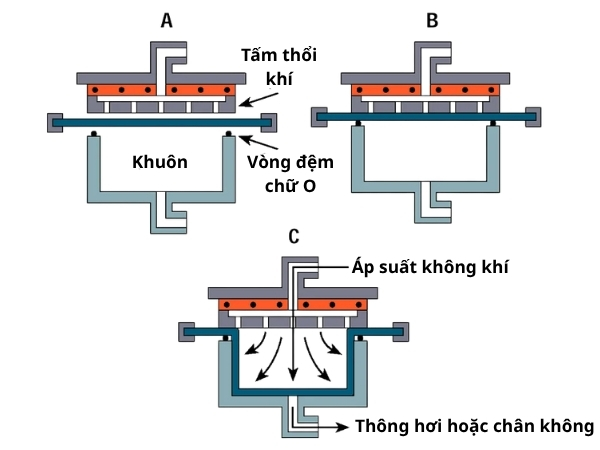
Operating principle of pressure forming
Structure of a pressure forming system
A pressure forming machine system consists of the following main components:
- Heating unit: Infrared heating lamps distribute heat evenly across the surface to soften the plastic sheet uniformly.
- Clamping frame: A cylinder system holds all four edges of the plastic sheet firmly and withstands high pressure during the air blowing stage.
- Forming mold: Typically made from aluminum, with small vent holes distributed across it. A female mold creates the external surface texture; a male mold forms the internal detail.
- Pressure box: A sealed chamber connected to an air compressor, responsible for releasing high-pressure compressed air onto the upper surface of the plastic sheet.
- Vacuum and cooling system: Evacuates trapped air and delivers cooling air or water to fix the part shape.
Advantages of pressure forming
Pressure forming delivers 4 major cost and technical benefits: sharp surface definition, low tooling cost, fast production lead time, and high flexibility for design changes.
- Sharp surface definition: High-force compressed air clearly reproduces complex lines, raised lettering, and textured patterns on the part.
- Tooling cost savings: Aluminum tooling for this technology costs approximately 3 to 10 times less than steel tooling used for injection molding.
- Shorter prototype lead time: Fast tooling production allows businesses to bring products to market sooner.
- Easy design adjustment: Engineers can readily modify aluminum mold geometry when product design upgrades are needed.

Pressure forming produces products with sharp surfaces
Limitations of pressure forming
Despite its many advantages, pressure forming has several technical and cost limitations - including difficulty forming deep undercuts, non-uniform wall thickness, sensitivity to operating parameters, and poor economics at very high production volumes.
- Difficulty forming deep undercuts: The technique struggles with features that have very deep recesses or require absolutely uniform wall thickness.
- Non-uniform part wall thickness: The plastic sheet stretches more at sharp corners and deep bases, thinning the wall in those areas.
- Higher defect rate with incorrect parameters: Inaccurate temperature easily causes warpage, air voids, or surface deformation.
- High cost at very large production volumes: For production volumes of millions of units, this method is less cost-efficient than injection molding technology.
Comparing pressure forming and vacuum forming
To choose the right technology, businesses can refer to the comparison table of pressure forming and vacuum forming below:
|
|
|
|
|
|
|
|
|
|
|
|
|
|
|
|
|
|
|
|
|
|
|
|
|
|
|
|
Applications of pressure forming
Pressure forming is widely used across 4 main sectors: packaging and plastic trays, electronic components, medical devices, and automotive and industrial applications.
Packaging and plastic trays
Manufacturers use this method to produce component-positioning trays, food blister packs, and snap-fit plastic containers. The method enables the container surface to clearly display brand logos and structural ribbing.
Electronic components
Pressure forming is widely used in the production of office machine housings, printer control panels, monitor bezels, and audio equipment enclosures. ABS or Polycarbonate plastic after forming delivers a premium textured surface finish resembling a metal housing.
Medical devices
The technology is used to process ultrasound machine housings, sterile surgical instrument trays, and blood analyzer casings. The resulting parts have smooth surfaces that are easy to clean with disinfectant chemicals and exhibit high mechanical durability.
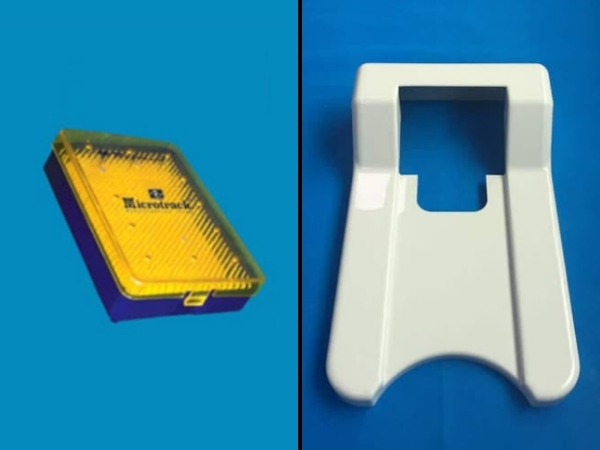
Medical devices manufactured using pressure forming
Automotive and industrial
Automotive plants use this technique to produce A/B/C pillar trim, secondary storage compartments, center control panels, and trunk liner trays. In industrial applications, the technology produces air compressor protective housings and machine tool guards.
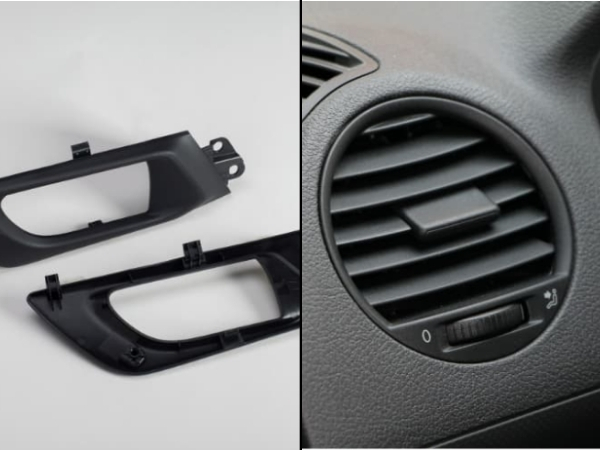
Automotive parts manufactured using pressure forming
Material optimization solutions for pressure forming
Input plastic sheet quality determines the dimensional accuracy of the part after heating. The most suitable thermoplastic sheet materials for pressure forming include:
- ABS resin pellets: Wide forming temperature range, good impact resistance, and easy surface painting.
- Polycarbonate (PC) resin pellets: High transparency, heat resistance, and strong impact resistance - suitable for medical device housings.
- PETG / PET resin pellets: Food-safe, good chemical resistance - used for formed trays and pharmaceutical blister packs.
- Polypropylene (PP) resin pellets: High toughness, lightweight - suitable for chemical containment trays and automotive components.
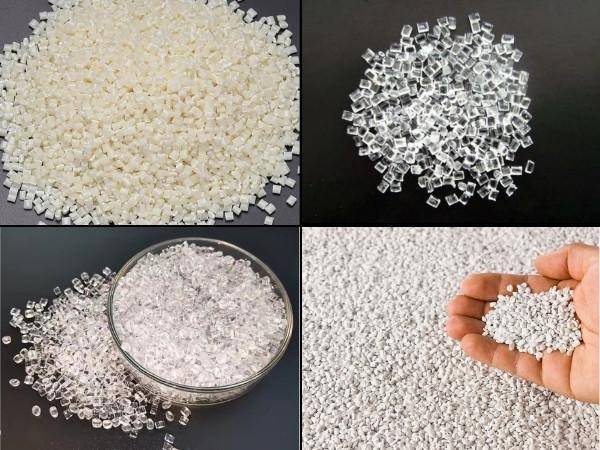
Materials suitable for pressure forming
Pressure forming delivers superior advantages in surface sharpness and cost efficiency for medium-volume orders. APEX Vietnam provides engineering resin solutions, Taical filler masterbatch, and optimized additives. These products increase rigidity, reduce shrinkage, and produce sharp surface definition in the forming process. Contact us now for technical consultation and optimal resin solutions for your plant.
Article Classification
Recent Articles
- What is pressure forming? How it works in the plastics industry
- Plastic Injection Mold: Types, Structure, and Operating Principle
- Common problems with plastic pelletizing machines and troubleshooting methods
- Top 7 Reputable Plastic Additives Companies in Vietnam
- Blending Plastic Additives: Formulas for PVC, PP, and PE