
NEWS & EVENTS

- Home
- News
- Products Information
- A Detailed Overview of the PE Film Production Process
A Detailed Overview of the PE Film Production Process
January 28,2026
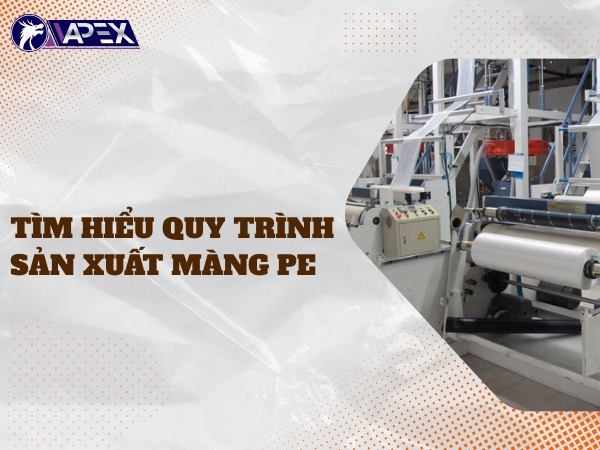
For businesses involved in manufacturing and using PE film, having a clear understanding of the PE film production process is a crucial basis for evaluating product quality. In this article, APEX Vietnam will provide an in-depth analysis of production methods, along with key technical factors that directly impact processing efficiency and final output quality.
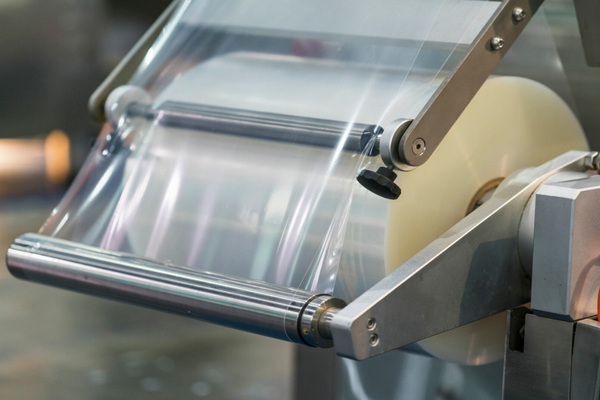
PE film is a thin plastic film produced from PE resin pellets
What Is PE Film?
PE film (Polyethylene film) is a thin plastic film produced from PE resin pellets. This material features good elasticity and offers effective resistance against water, dust, and external environmental factors. PE film is widely used in packaging, cargo securing, pallet wrapping, and food preservation during storage and transportation.PE film is a thin plastic film produced from PE resin pellets
On today’s market, PE film is commonly divided into the following two main categories:
PE film is versatile enough to meet the demands of various industries
PE film production process by the casting method
PE film production process by the blown film method
APEX specializes in producing PE Filler Masterbatch for plastic processing lines
- Hand wrap PE film: Featuring moderate roll sizes and lightweight design, this type is suitable for manual handling and is widely used in small-scale packaging operations.
- Machine wrap PE film: Designed for use with specialized pallet wrapping machines, this type has longer roll lengths and heavier weight, meeting the requirements of industrial packaging applications.
How Is PE Film Applied?
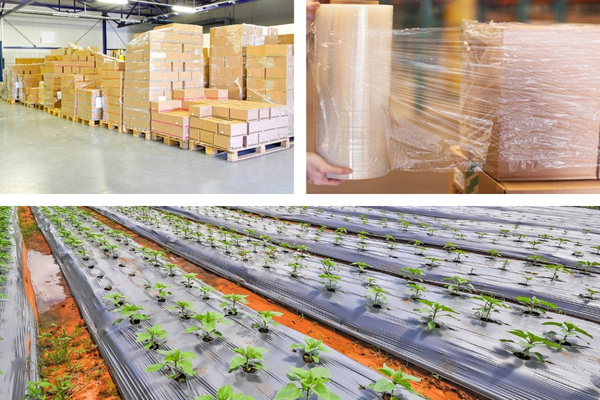
Depending on production technology, film thickness, and material formulation, PE film can meet a wide range of usage requirements across various manufacturing and service sectors.- Consumer packaging industry: PE film is a common material in the production of flexible packaging such as plastic bags, food wrap films, and consumer goods packaging.
- Industrial packaging: It is used for pallet wrapping, load stabilization, and surface protection of products, helping minimize environmental impacts during transportation and storage.
- Agricultural applications: PE film is used as agricultural covering material, for wrapping crops and agricultural products, helping regulate moisture levels and reduce the effects of unfavorable weather conditions.
- Medical sector: Thanks to its chemical resistance and safety when used in compliance with standards, PE film is applied in the production of medical packaging and disposable medical products.
PE film is versatile enough to meet the demands of various industries
PE Film Production Process
In the PE film production process, depending on whether the calendering method or the blown film method is applied, the production stages will be adjusted accordingly.PE Film Production Process Using the Calendering Method
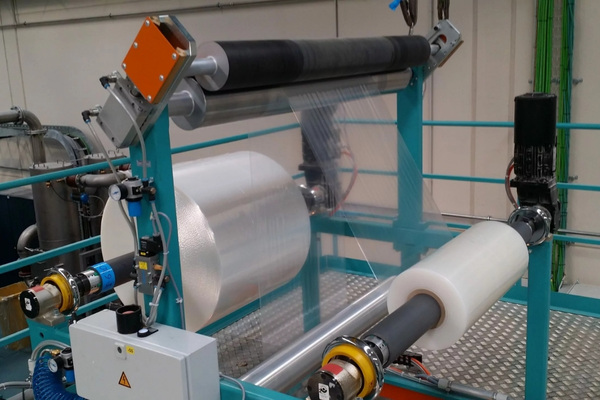
The calendering method is commonly used to produce thin, flat films with high adhesion, especially when laminated onto other materials such as kraft paper to create waterproof packaging, or for applications that require precise thickness control.- Step 1: PE resin pellets are thoroughly mixed with additive pellets (such as toughness enhancers, UV-resistant additives, or color masterbatches) at a specified percentage ratio.
- Step 2: The mixture is fed into the extruder, where temperatures ranging from 200°C to 275°C melt the plastic. The molten plastic then passes through a screen filter to remove impurities or unmelted resin particles.
- Step 3: The molten plastic is forced through a narrow slit of a T-shaped die, allowing the material to be evenly spread horizontally.
- Step 4: The hot plastic film is pressed directly onto chilled calender rollers. At this stage, the film is shaped and rapidly cooled.
- Step 5: After cooling, excess edges are trimmed off, and the film is wound onto paper cores according to the required dimensions.
PE film production process by the casting method
PE Film Production Process Using the Blown Film Method
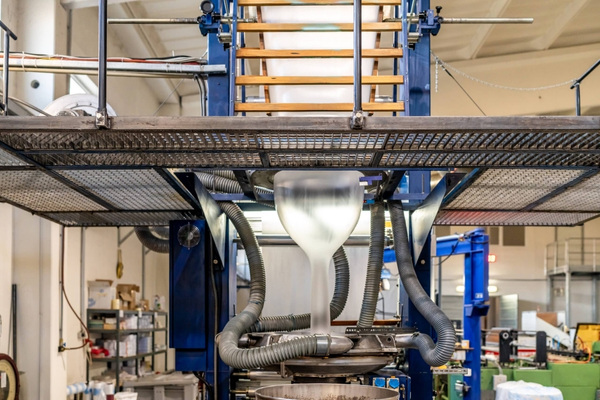
PE film is produced using the blown film method when high elongation, good elasticity, and high strength are required, making it suitable for pallet wrapping, moisture and dust protection, and related applications. The PE film production process using this method is carried out as follows:- Step 1: PE resin pellets are prepared and mixed with additives in a manner similar to the calendering method.
- Step 2: The material mixture is fed into the extruder and heated to a temperature range of 200 – 275°C, where the resin melts and is forced through a metal screen filter to remove impurities.
- Step 3: The filtered molten plastic is directed into an annular die, forming a thin plastic tube with a circular cross-section.
- Step 4: Air is introduced into the center of the die to inflate the plastic tube, creating a film bubble. The bubble diameter and film thickness are controlled according to preset parameters.
- Step 5: After inflation, the film tube is rapidly cooled by a high-speed air ring system surrounding it, helping stabilize the film’s structure and dimensions.
- Step 6: Once a stable temperature is reached, the film tube passes through a set of nip rollers to be flattened, transforming it from a tubular form into a flat film.
- Step 7: The flattened PE film forms a double-layer film, which can either be kept intact or slit into two single layers, then continues through the roller system to be wound into finished rolls.
PE film production process by the blown film method
APEX Vietnam Supplies High-Quality PE Filler Masterbatch
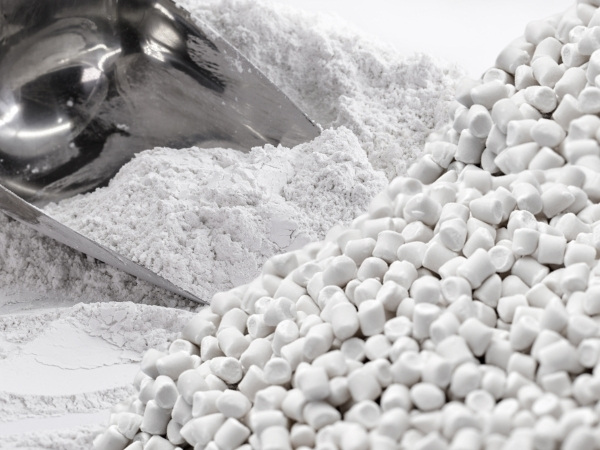
APEX Vietnam specializes in the research and production of PE Filler Masterbatch for plastic processing lines, particularly for the PE film production process using both blown film and calendering methods. The products are engineered to ensure stable processing performance, precise thickness control, and cost optimization for plastic film manufacturers.APEX specializes in producing PE Filler Masterbatch for plastic processing lines
APEX masterbatch products use Polyethylene (PE) as the base resin, combined with ultra-fine calcium carbonate with an average particle size ranging from 1.8 to 3.3 μm, ensuring uniform dispersion during the melting process. The high CaCO₃ content, ranging from 75% to 88%, allows effective partial replacement of virgin resin while maintaining the essential mechanical properties required for PE film.
Ability to meet PE film production requirements:
Ability to meet PE film production requirements:
- Stable processing and line operation: Uniform melting behavior within the common PE processing temperature range helps reduce air bubbles, film deformation, and thickness fluctuations, enabling continuous production with a low scrap rate.
- Improved mechanical properties of the film: The combination of PE base resin and CaCO₃ enhances stiffness, shape retention, and abrasion resistance, improving film stability during packaging and end use.
- Optimized production costs: Allows partial replacement of virgin resin in the formulation, contributing to cost reduction while maintaining processing efficiency and product quality.
- Compatibility with multiple technologies: Suitable for blown film, extrusion, injection molding, and calendering processes, meeting the needs of various industrial applications.