
NEWS & EVENTS

- Home
- News
- Products Information
- What is HDPE Plastic? Detailed Properties and Applications
What is HDPE Plastic? Detailed Properties and Applications
March 10,2026
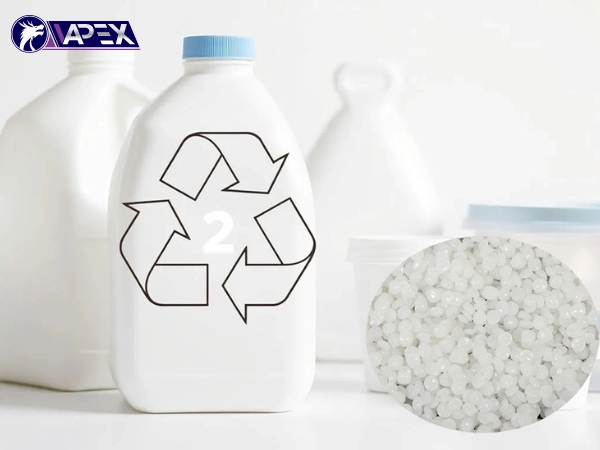
To optimize product quality and control raw material costs, understanding what is HDPE plastic plays an important role in the manufacturing process. In this article, APEX Vietnam will analyze in detail the properties, advantages, disadvantages, and practical applications of HDPE in industry.
HDPE plastic is commonly used in the packaging industry and in the production of industrial plastic products such as plastic crates, plastic pallets, water supply and drainage pipes, discharge pipes, storage tanks, chemical containers, children’s toys, as well as various construction materials.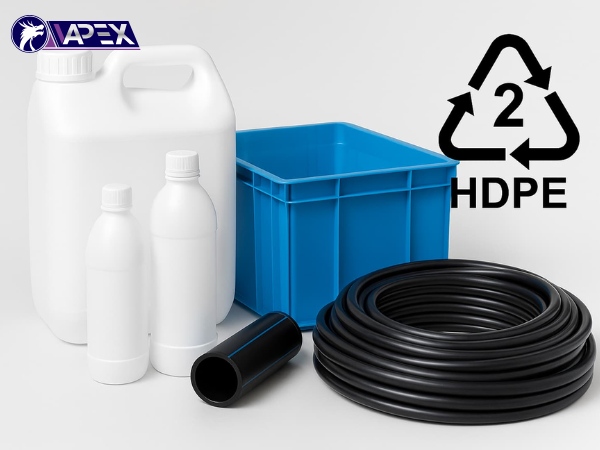
HDPE plastic stands for High-Density Polyethylene
What is HDPE plastic?
HDPE plastic stands for High-Density Polyethylene – a thermoplastic polymer with high density, synthesized from ethylene monomers derived from petroleum. HDPE offers high mechanical strength, strong load-bearing capacity, moisture resistance, chemical corrosion resistance, and good stability against environmental factors.HDPE plastic is commonly used in the packaging industry and in the production of industrial plastic products such as plastic crates, plastic pallets, water supply and drainage pipes, discharge pipes, storage tanks, chemical containers, children’s toys, as well as various construction materials.
HDPE plastic stands for High-Density Polyethylene
In the Resin Identification Code (RIC) system, HDPE is assigned the number 2, which is commonly printed on the bottom of products to help consumers easily identify and recycle the material.
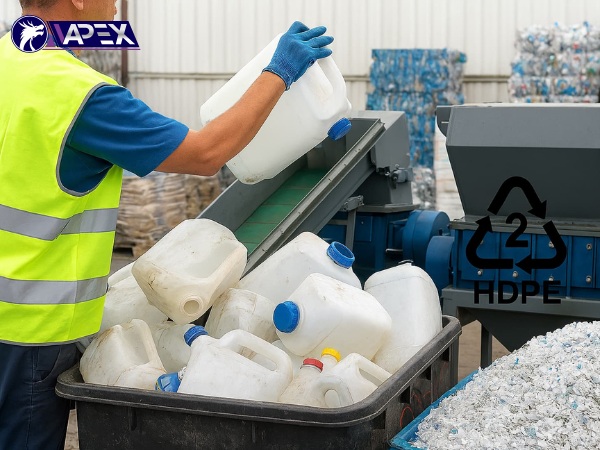
HDPE is environmentally friendly and easy to recycle
Depending on the blending ratio and application purpose (plastic pipes, pallets, packaging, containers, etc.), manufacturers will adjust the filler content to maintain a balance between mechanical strength and economic efficiency.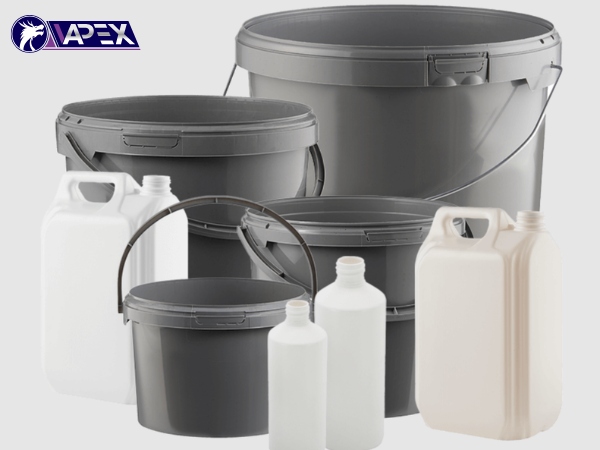
HDPE is used to manufacture bottles and specialized containers
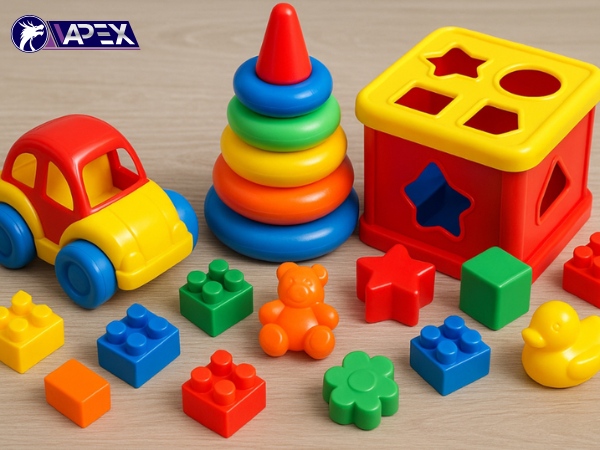
HDPE is non-toxic and suitable for producing children’s toys
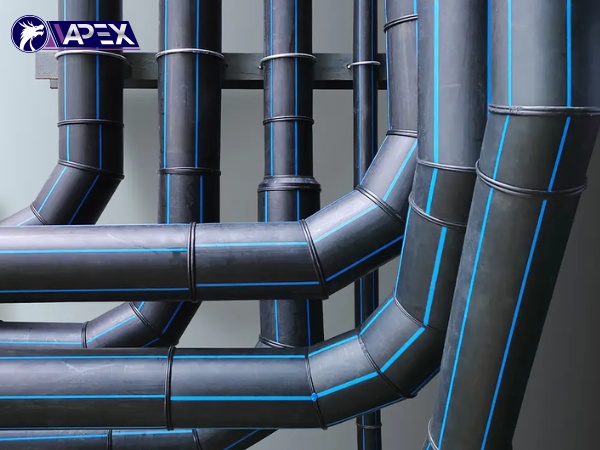
HDPE is widely used in the plastic pipe manufacturing industry
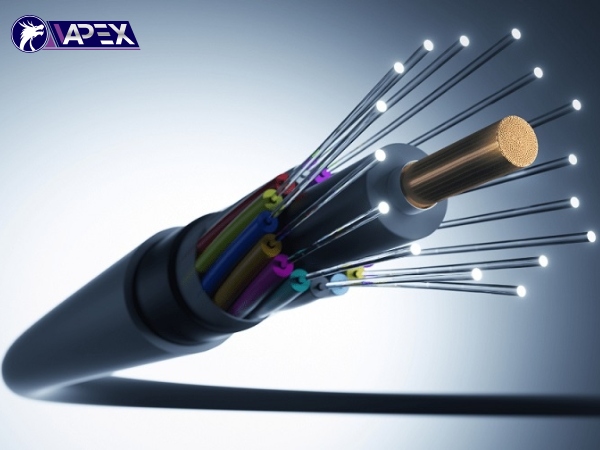
HDPE is used as a protective sheath for fiber optic cables installed underground or in conduits
Technical composition and structure:
Through this article, we hope businesses now better understand what is HDPE plastic, along with its properties, advantages, and limitations. Although HDPE offers many benefits in terms of mechanical durability, proper additive blending is still essential to achieve optimal economic efficiency. Contact APEX Vietnam for consultation on Filler Masterbatch solutions and optimal compounding formulas for specific product lines.
What are the properties of HDPE plastic?
The properties of HDPE plastic include being lightweight, tough, water-resistant, safe, and easily recyclable, specifically:- Resistant to corrosion from acids, alkalis, salts, and common solvents.
- Low density (0.93 – 0.97 g/cm³).
- Cold resistance down to –40°C, tensile strength >21 MPa.
- Waterproof and highly resistant to sunlight.
- BPA-free and environmentally friendly.
- Melting temperature around 130°C – 180°C.
Advantages of HDPE plastic
HDPE is considered a high-performance plastic material that meets technical requirements in both industrial and residential applications. Its key advantages include:- High durability and long service life: Excellent impact resistance, less prone to cracking, and stable performance under harsh weather conditions or complex terrains.
- Chemical corrosion resistance: Inert to most acids, alkalis, and salts, making it suitable for clean water pipelines, chemical transport systems, and wastewater treatment.
- Lightweight and flexible: Easy to transport and install, reducing labor costs; it can also bend slightly, helping minimize joints.
- Weather and UV resistance: Good resistance to ultraviolet rays, slow aging, and less brittleness during long-term outdoor use.
- Safe and environmentally friendly: Non-toxic, commonly used for food packaging and containers; fully recyclable.
- Cost-effective: Reasonable cost with low maintenance expenses; the smooth inner surface helps reduce scaling and maintain long-term performance.
HDPE is environmentally friendly and easy to recycle
Disadvantages of HDPE plastic
Despite its many advantages, HDPE still has several limitations that should be considered during product design and application:- Susceptible to cracking under thermal shock: When temperature changes suddenly, the material may develop cracks or deformation as its molecular structure is affected.
- Low gloss and prone to scratching: The surface of HDPE is not highly glossy and can be scratched by strong impacts, which may reduce the aesthetic appearance of the product.
- Limited heat resistance: At high temperatures (above about 120°C), HDPE may experience a decline in mechanical properties and is not suitable for prolonged high-temperature environments.
- Affected by UV radiation if not stabilized: When exposed to sunlight for long periods without UV stabilizers, the material may fade, lose elasticity, and gradually decrease in durability.
Depending on the blending ratio and application purpose (plastic pipes, pallets, packaging, containers, etc.), manufacturers will adjust the filler content to maintain a balance between mechanical strength and economic efficiency.
Common applications of HDPE plastic
HDPE plastic is widely used in many fields, from household products to heavy industry, including:Production of bottles and specialized containers
HDPE has good rigidity, high impact resistance, and is easy to recycle, so it is commonly used to manufacture plastic bottles, chemical containers, pesticide storage tanks, and specialized solvent containers. This material helps ensure safety during storage and transportation.HDPE is used to manufacture bottles and specialized containers
Household products and children’s toys
With its non-toxic and durable properties, HDPE is a popular choice for manufacturing children’s toys. In addition, many household products such as trash bins, storage boxes, plastic cabinets, and plastic tables and chairs are also made from HDPE thanks to its strength and long service life.HDPE is non-toxic and suitable for producing children’s toys
Piping and water treatment systems
HDPE is widely used in the plastic pipe manufacturing industry due to its corrosion resistance and leak-proof properties. It is suitable for clean water supply pipes, urban wastewater drainage pipes, pipelines used in mining industries, electrical conduit pipes, hot and cold water pipes, and many other infrastructure systems.HDPE is widely used in the plastic pipe manufacturing industry
Fiber optic cable protection
In the telecommunications sector, HDPE is used as a protective sheath for fiber optic cables installed underground or inside conduits. The material provides compression resistance, waterproof capability, and protection against mechanical impacts from soil and rocks. Its chemical stability also helps minimize the effects of moisture and microorganisms in underground environments.HDPE is used as a protective sheath for fiber optic cables installed underground or in conduits
APEX Vietnam provides high-quality Filler Masterbatch for the plastics industry
As businesses increasingly face pressure from raw material costs, production efficiency, and quality standards, selecting the right additives for HDPE plastic plays a crucial role. APEX Vietnam offers specialized PE Filler Masterbatch for the plastics industry, helping manufacturers optimize both technical performance and economic efficiency.Technical composition and structure:
- Base material: Polyethylene (PE), which is highly compatible with HDPE resin systems.
- Filler: Ultra-fine calcium carbonate (CaCO₃) with an average particle size of 1.8 – 3.3 μm.
- High CaCO₃ content: The filler ratio ranges from 75 – 88%, ensuring optimal replacement of virgin resin while maintaining product performance.
Through this article, we hope businesses now better understand what is HDPE plastic, along with its properties, advantages, and limitations. Although HDPE offers many benefits in terms of mechanical durability, proper additive blending is still essential to achieve optimal economic efficiency. Contact APEX Vietnam for consultation on Filler Masterbatch solutions and optimal compounding formulas for specific product lines.