
BLOG

- Home
- Blog
- Plastic Polymer Composite Article
- Comparison of CPVC plastic and PVC plastic
Comparison of CPVC plastic and PVC plastic
August 06,2026
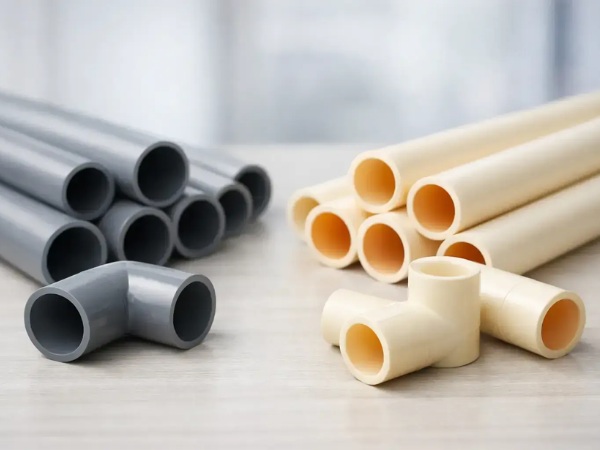
CPVC plastic and PVC plastic are both thermoplastic materials widely used in construction, electrical, water supply and drainage, and industrial manufacturing. However, each offers distinct technical properties, heat resistance levels, chemical durability, and cost profiles. Understanding differences between these plastics helps businesses choose right materials, optimize quality, and improve production efficiency.
What Is PVC Plastic?
PVC plastic (Polyvinyl Chloride) is a thermoplastic widely used in construction, electrical, medical, and industrial applications. Its competitive pricing, high durability, and processing versatility have made it one of the highest-volume plastics consumed globally.
Basic specifications:
- Technical name: Polyvinyl Chloride (PVC)
- Chemical formula: (C₂H₃Cl)ₙ
- Glass transition temperature (Tg): approximately 80°C
- Processing temperature: 150 - 210°C
.jpg)
PVC plastic is a thermoplastic material
PVC has an amorphous structure and therefore has no fixed melting point. During production, heat stabilizers are typically added to prevent thermal degradation at elevated temperatures.
Key properties of PVC:
- Cost-effective: Low production cost and wide availability.
- High mechanical strength: Good load-bearing capacity, impact resistance, and long service life.
- Adjustable hardness: Can be produced in rigid or flexible forms by varying plasticizer content.
- Reasonable flame resistance: Self-extinguishing when the heat source is removed.
- Chemical and corrosion resistance: Compatible with a wide range of working environments.
Common PVC types:
- Rigid PVC (uPVC): Contains no plasticizer; offers high stiffness and load-bearing performance.
- Flexible PVC: Plasticizer is added to increase softness and elasticity.
Applications of PVC Plastic
Thanks to its durability, corrosion resistance, and cost efficiency, PVC remains an essential material across many industries:
- Construction: Water pipes, pipe fittings, plastic doors and windows, wall cladding, plastic flooring.
- Electrical and electronics: Cable sheathing, electrical conduit.
- Medical: Blood bags, IV tubing, medical catheters.
- Automotive: Seat upholstery, floor mats, interior trim components.
- Packaging: Shrink film, blister packs, thermoformed packaging.
- Consumer goods: Raincoats, boots, plastic curtains, floor mats.
.jpg)
PVC plastic is used in the electrical and electronics industry.
What Is CPVC Plastic?
CPVC (Chlorinated Polyvinyl Chloride) is produced by chlorinating PVC resin, increasing the chlorine content within the molecular structure. This process gives CPVC significantly superior heat resistance, flame retardancy, and chemical resistance compared to standard PVC.
Basic specifications:
- Technical name: Chlorinated Polyvinyl Chloride (CPVC)
- Representative chemical formula: (C₉H₁₁Cl₇)ₙ
- Density: approximately 1.51-1.58 g/cm³
- Glass transition temperature (Tg): 100-130°C
- Vicat softening point: above 140°C
- Continuous service temperature: up to approximately 93°C
.jpg)
CPVC plastic is produced by chlorinating PVC plastic.
Key properties of CPVC:
- High heat resistance: Maintains pressure-bearing capacity and mechanical strength at temperatures up to 93°C.
- Good mechanical strength: Effective load-bearing, impact resistance, and dimensional stability under stress.
- Good thermal insulation: Low thermal conductivity helps minimize heat loss in hot water systems.
- Superior flame retardancy: Difficult to ignite and self-extinguishing when the heat source is removed.
- High chemical resistance: Resistant to strong acids, alkalis, salts, and a wide range of industrial chemicals.
Applications of CPVC Plastic
Thanks to its outstanding heat resistance and chemical durability, CPVC is widely used in:
- Hot and cold water supply systems: Residential, hotel, hospital, and commercial building installations.
- Industrial pipelines: Conveying chemicals, acids, alkalis, wastewater, and process solutions.
- Sprinkler fire suppression systems: Automatic water spray pipelines in civil and industrial buildings.
- HVAC systems: Circulating hot water pipelines and condensate return lines.
.jpg)
CPVC is widely used in industrial piping systems.
Comparison of CPVC plastic and PVC plastic
Below is a detailed comparison table between CPVC and PVC plastics based on technical criteria and real-world applications.
|
Criteria |
PVC plastic |
CPVC plastic |
|
Heat resistance |
Low. Maximum 140°F (60°C). |
High. Performs well at 200°F (93°C); maximum up to 230°F. |
|
Chemical resistance |
Moderate. Susceptible to degradation by certain aggressive chemicals over time. |
Superior. Resistant to strong acids, alkalis, bases, and high-concentration corrosives. |
|
Mechanical properties |
More ductile and impact-resistant at room temperature; less prone to stress cracking. |
Harder and more brittle than PVC at room temperature, but retains good flexural strength at elevated temperatures. |
|
Flame retardancy |
Self-extinguishing when isolated from the ignition source. |
Excellent flame retardancy (superior to PVC); harder to ignite and produces very little smoke. |
|
Typical applications |
• Residential cold water supply and drainage pipes. • Cable insulation sheathing. • Packaging films, shrink films, raincoats. |
• Domestic hot and cold water piping systems.
• Industrial chemical pipelines.
• Automatic fire spinkler system. |
|
Recyclability |
Easier. Recyclable by standard mechanical processes. |
More difficult. Higher chlorine content requires specialized chemical treatment processes. |
|
Cost |
Lower. Common raw material, simple production process. |
Higher. Elevated production cost due to the complex chlorination process. |
Should You Choose PVC or CPVC?
The choice between PVC and CPVC depends on the technical requirements of the end product and the production budget.
- Choose PVC when the product does not require high heat resistance, when competitive pricing is a priority, and when manufacturing at high volume. PVC is well suited for cold water pipes, electrical cables, packaging film, plastic sheeting, building materials, and a wide range of everyday consumer products.
- Choose CPVC for high-temperature environments, corrosive chemicals, or strict fire safety requirements. CCPVC is a suitable choice for hot water piping, chemical pipelines, fire sprinkler systems, and specialized industrial equipment.
In terms of cost, PVC remains the more widely used material due to its lower price and processing flexibility. However, for applications that demand high performance and long service life in demanding environments, CPVC delivers superior functional value and a stronger long-term return on investment.
.jpg)
PVC is suitable for electrical cables and common consumer products.
APEX Vietnam - Custom PVC Compound Supplier for Every Application
APEX Vietnam specializes in supplying PVC compound pellets that are researched and formulated according to specific application requirements, serving diverse fields such as plastic pipes, electrical cables, construction materials, technical fittings, and industrial plastic products. With stable raw material sources, consistent quality, and an experienced technical team, APEX Vietnam supports businesses in optimizing production efficiency, improving product quality, and effectively controlling costs.
From the comparison between CPVC plastic and PVC plastic, each material has its own advantages suited to different product groups and usage conditions. PVC is a cost-effective choice for general applications, while CPVC is suitable for products requiring high heat resistance and chemical resistance. To achieve optimal production efficiency, businesses should consider technical requirements, budget, and end-use objectives simultaneously.