
NEWS & EVENTS

- Home
- News
- Products Information
- EXPLORING THE ROLE OF CALCIUM CARBONATE IN NON-WOVEN FABRIC PRODUCTION
EXPLORING THE ROLE OF CALCIUM CARBONATE IN NON-WOVEN FABRIC PRODUCTION
May 23,2026
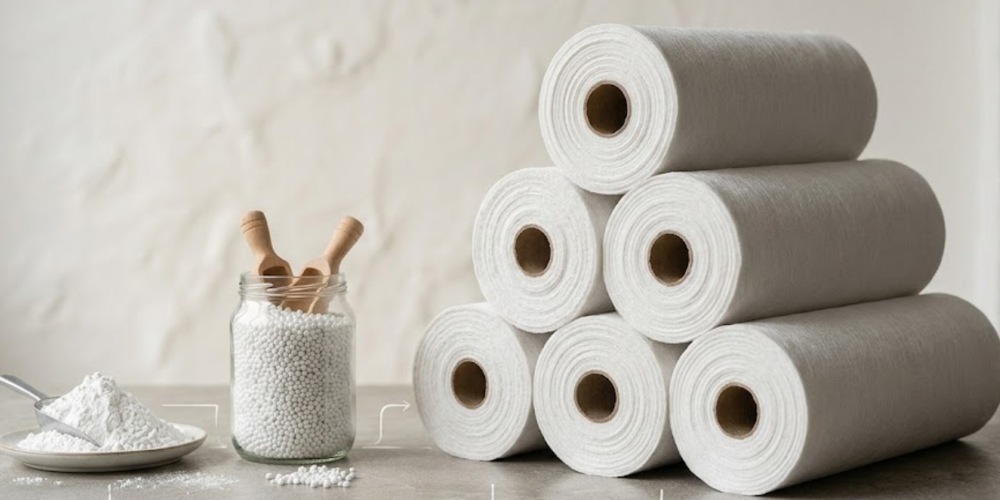
In today's nonwoven fabric manufacturing industry, optimizing raw material costs while maintaining product quality is a key concern for many businesses. One of the most common solutions currently being widely applied is the use of calcium carbonate (CaCO₃) as a filler. This is considered a supporting component that helps improve production efficiency and brings many economic benefits to businesses.
Thanks to its good dispersion ability and high whiteness, CaCO3 is widely used in the production of non-woven fabric bags, face masks, medical packaging, and many other industrial products.
The cost of virgin plastic is usually quite high and fluctuates according to the market. Adding CaCO3 to the mixing formula helps businesses reduce the amount of plastic used, thereby saving on raw material costs while still ensuring production efficiency.
What is calcium carbonate filler?
Calcium carbonate is a natural mineral whose main component is ultra-fine crushed limestone. In the plastics and non-woven fabrics industry, CaCO3 is often blended with PP resin to create Filler Masterbatch – an additive that helps reduce the cost of raw materials while maintaining the necessary properties of the product.Thanks to its good dispersion ability and high whiteness, CaCO3 is widely used in the production of non-woven fabric bags, face masks, medical packaging, and many other industrial products.
The role of calcium carbonate in the production of nonwoven fabrics.
During the manufacturing process, CaCO3 filler provides practical benefits for businesses.
Helps optimize production costs.
.png)
The cost of virgin plastic is usually quite high and fluctuates according to the market. Adding CaCO3 to the mixing formula helps businesses reduce the amount of plastic used, thereby saving on raw material costs while still ensuring production efficiency.
Improve machining capabilities
When mixed in the right proportions, calcium carbonate helps to stabilize the flow of raw materials during the spinning and fabric making process. This supports smooth machine operation, reducing mold sticking or yarn breakage during production.
Increase the hardness and durability of the product.
CaCO3 contributes to improving the surface stiffness and shapeability of nonwoven fabrics. For certain product lines such as shopping bags or industrial packaging, this is a crucial factor in enhancing product quality.
.png)
Helps to enhance whiteness and aesthetics.
High-quality limestone powder with good whiteness will help nonwoven fabrics have brighter colors, a more beautiful and uniform surface after production. This is especially important for nonwoven fabrics used in medical, packaging, and consumer goods applications.
Applications of calcium carbonate-containing nonwoven fabrics.
Thanks to the above benefits, Calcium Carbonate is used in many lines of nonwoven fabric products such as:
-
Environmentally friendly non-woven fabric bags
-
Face masks and disposable medical products
-
Agricultural materials and filter materials
Calcium Carbonate – The Optimal Solution for the Nonwoven Fabric Industry
In the context of the rapidly developing nonwoven fabric industry, calcium carbonate has affirmed its role as a crucial raw material in the production process. Besides contributing to cost and material reduction, calcium carbonate also helps improve product properties and enhance processing efficiency. The rational application of calcium carbonate will help businesses optimize production processes, increase competitive advantages, and better meet the increasingly demanding requirements of the market.